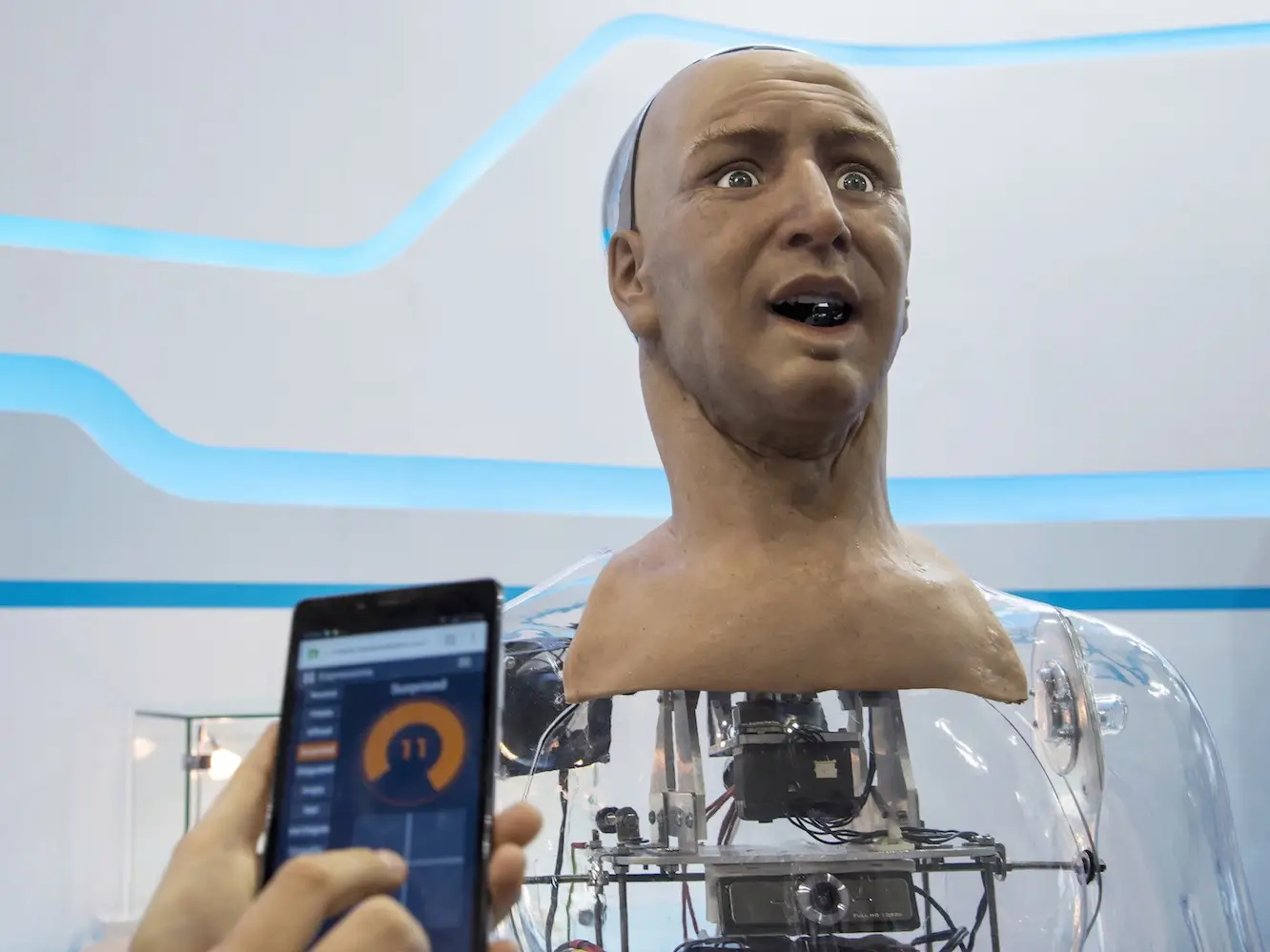

Recent advancements in humanoid robotics are transforming what’s possible in AI-driven technology, and two leading innovators, EngineAI and Clone Robotics, are at the forefront. EngineAI’s SE01 humanoid robot, powered by sophisticated AI neural networks, exemplifies smooth, human-like movement and raises the bar for realism in robotics. Meanwhile, Clone Robotics pushes boundaries even further with a revolutionary synthetic muscles and joints, meticulously designed to mimic the human musculoskeletal system. These groundbreaking innovations signal a new era in robotics, where androids exhibit movement, dexterity, and behavioral responses that closely resembles human abilities.
This achievement combines breakthroughs in material science, robotics, and AI, signaling a new era where machines not only understand commands but can also physically execute them with lifelike precision.
Key Features of Synthetic AI Humans with Real Muscles
1. Realistic Muscle Movement and Response
The inclusion of real muscle fibers allows these synthetic AI humans to move with a fluidity and precision that closely mirrors human anatomy. The muscles are made from bioengineered materials that respond to electric signals, contracting and relaxing in a natural manner. This innovation enables a synthetic AI to lift objects, maintain balance, and interact in a more nuanced way with its surroundings.
2. Advanced Interaction Capabilities
These AI humans are equipped with advanced sensory systems, allowing them to respond to touch, voice, and visual stimuli in real time. Combined with machine learning algorithms, the synthetic human can engage in more lifelike and natural interactions, responding to environmental changes or even recognizing and interpreting facial expressions of human counterparts.
3. Lifespan and Durability
Bioengineered muscles are built to last, making these synthetic humans more durable than previous robotic models. They are resistant to wear and tear, enabling them to perform repetitive tasks without breakdowns, a significant improvement over the mechanical components typically used in robotics.
4. Enhanced Emotional and Social Response
AI technology in these synthetic humans is designed to process emotional cues and engage in social contexts, whether through speech, gestures, or facial expressions. This feature enhances their utility in industries like healthcare and customer service, where empathetic and engaging interaction is critical.
5. Customizable for Various Industries
The underlying framework allows for customization, meaning that businesses in different sectors can adapt the technology to meet specific needs. For instance, hospitals can use them as companion bots for patients, while companies can deploy them as customer service agents.
The integration of advanced AI, neural networks, and synthetic muscle systems in these humanoid robots brings us closer than ever to creating androids capable of complex, lifelike interactions. These technologies promise not only to redefine the robotics field but to transform industries—from healthcare and customer service to entertainment—by introducing robots that can understand, move, and interact in ways previously thought to be uniquely human.